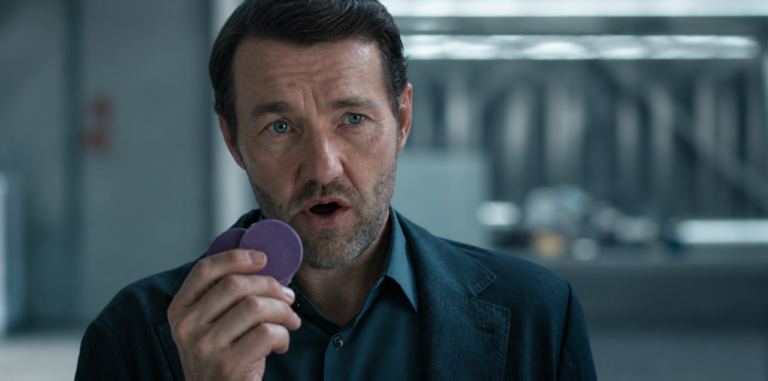
Oluko’s drug-free escape reveals a new use of consciousness in the Dark Matter Season 2 finale.
Oluko escapes without the drug in the Dark Matter Season 2 finale because he can control his consciousness well enough to achieve the state normally enabled by the compound. The official Episode 210 podcast confirms his departure is drug-free. However, he still uses the pyramid, so the scene does not establish travel without equipment.
Watch the full breakdown below, then keep reading for the evidence, additional questions raised by the episode, and what it could mean going forward.
Spoilers through Dark Matter Season 2 Episode 10, “No Quiet Life.” Jason 2 takes the patches, but Oluko enters the pyramid, concentrates and disappears. That raises a fair question: if other travelers already use mental focus, what has Oluko learned to do differently?
How did Oluko escape without the drug?
Oluko reaches the necessary state through control of his own consciousness. The explanation comes from Dark Matter: The Official Podcast, Episode 210, which explicitly discusses his disappearance without the drug and connects it to mindfulness and superposition.
That clarification matters because the scene alone leaves room to wonder whether he took an earlier dose. Jason removing the available patches does not independently prove that no medication was already active. The official discussion resolves the intended explanation.
The supported conclusion is that Oluko bypasses chemical assistance during this escape. It does not establish that every traveler can do the same, that he can teach the ability, or that he no longer needs working equipment.
Why is this different from Amanda teaching Ryan to focus?
Amanda teaches Ryan how to influence a destination during a chemically assisted journey. Oluko demonstrates an additional ability: accessing the required state without that assistance.
In Episode 2, Amanda takes the first turn before asking Ryan to choose a door. She tells him to focus on a positive memory of home or a person. Ryan can reproduce the compound, but he still needs instruction in navigating the corridor.
The finale uses a similar emotional technique when the Jason helping Daniela find Charlie brings up the memory of Max cutting Charlie’s hair. As Daniela reconnects with that experience, Jason selects a door he believes will bring her closer to her son.
These scenes show memories helping guide travel. They do not show those travelers dispensing with medication. I read Oluko’s feat as an extension of the show’s consciousness rules, rather than evidence that everyone could have skipped the drug simply by concentrating harder.
How the earlier meditation scenes prepare Oluko’s escape
Oluko’s meditation practice predates the finale, giving his new capability an established foundation. The early contrast between an idealized white room full of followers and his smaller, dingier actual gathering connects mental discipline with his aspirations.
The injured Leighton has a practical reason to seek him out. His frightening journeys have demonstrated the consequences of carrying fear from one world into the next. A version of himself who teaches mental discipline offers expertise he needs.
Earlier, that partnership could be understood mainly through navigation. The finale expands its significance by showing Oluko achieving the state normally enabled by the drug. However, the preparation does not reveal when he learned the technique or prove that he used it during every earlier journey.
The idealized gathering also remains open to interpretation. It can express the influence Oluko wants without being a confirmed prophecy of his future.
Did Oluko already have a hidden patch?
A hidden patch is a reasonable initial interpretation, but the official podcast identifies the escape as drug-free. Sandra’s visible patch explains why viewers might consider the alternative.
When Sandra confronts Jason and Blair, she displays the patch on her wrist and refers to trials. Medication can therefore already be active without an injection immediately before entry. The absence of a visible dose is not sufficient proof on its own.
The patch belongs to an ongoing development effort. During the Episode 7 tour, the project targets 30 days, with trials reportedly reaching two weeks at that stage. Those figures distinguish the goal from the demonstrated result; they do not prove every finale patch lasts a month.
My earlier breakdown of the blind spot in Leighton’s pyramid plan examines what extended travel demands of his safeguards. Here, the patch provides a credible chemical explanation to test. The official clarification rules it out for Oluko’s demonstrated escape.
Why does Oluko kill Leighton?
Oluko kills Leighton after Leighton decides the project needs to stop and supports shutting down existing access. Their disagreement turns violent when Leighton’s withdrawal threatens the undertaking they have built together.
Leighton returns with necessary components, but his experiences have changed his judgment. The crop intervention caused harm, while the cure in the plague world benefited the rich as others suffered. The finale advances the doubts discussed in my Episode 9 analysis of whether Leighton would end the pyramid project into an actual decision.
Oluko refuses to accept that decision. He strikes Leighton and strangles him. His earlier response to Blair’s rejection, having Sandra keep her under observation, now sits beside a much more extreme reaction to opposition within the partnership.
In the official podcast, Dayo Okeniyi discusses the murder through Oluko’s relationship with another version of himself. He experiences that counterpart’s willingness to stop as a betrayal of their shared ambition. This interpretation helps explain the scene without requiring an invented offscreen murder plan.
Why does Oluko look away while strangling Leighton?
The official discussion connects Oluko looking away with his inability to bear watching his own face die, and with the image that could remain in his mind. Okeniyi relates the director’s approach to the mental fluidity travel requires.
For me, that detail connects the murder to the escape more specifically than describing Oluko as calm or enlightened. He relies on his mind to travel while committing an act that could disturb it. Looking away does not establish that he removes guilt, prevents trauma or unlocks his ability through murder.
Does the pyramid still work after the finale?
Oluko’s escape does not prove that the pyramid remains operational after Jason 2 uses its shutdown code. He departs before that intervention, so his successful use establishes an earlier opportunity.
The finale includes two shutdown actions: Jason and Blair carry out their operation against the original Box network, while Jason 2 separately uses Leighton’s pyramid code. Treating those actions as identical obscures the order relevant to Oluko.
Using a shutdown code does not establish permanent physical destruction. However, it also does not guarantee that another command can restart the machine. Continued operation and future restoration remain unresolved.
Can Oluko travel without the Box or rescue Daniela and Charlie?
Travel without equipment is unproven, and Oluko is not established as Daniela and Charlie’s only possible rescuer. His escape takes place inside the pyramid, while their destination and a functioning rescue route remain unresolved.
A rescue would require more than one person’s ability to bypass medication. Someone would need working equipment, the knowledge to use it and a way to locate the missing travelers. Jason 2 also has technical knowledge of the project, so the finale does not establish that Jason must bargain with Oluko.
Oluko’s departure likewise does not reveal where he went. His claim that Leighton permitted him to find a new home conceals the murder, making it an unreliable basis for a detailed account of his destination or long-term intentions.
What Oluko’s escape changes going forward
Established: Oluko departs without the drug, uses the pyramid and gets away before Jason 2 shuts it down. His mental discipline has not prevented him from killing a partner who wants to stop.
Supported implication: if he reaches functioning equipment again, withholding medication cannot be assumed to prevent another journey. Anyone trying to limit his access would have to account for the equipment and his opportunity to use it.
Ryan’s work still matters to travelers who have not demonstrated Oluko’s ability. The exception changes the restrictions applicable to Oluko; it does not automatically give every traveler the same independence.
Dark Matter finale FAQ
Did the pyramid remove the drug requirement for everyone?
No universal drug-free capability is established. The official explanation attributes Oluko’s feat to his consciousness, rather than demonstrating that every person entering the pyramid can do it.
Can Oluko teach other people to travel without drugs?
The finale does not establish whether he can teach the ability. His role as a meditation teacher makes the possibility relevant, but performing the feat himself does not prove he can transfer it.
Who plays Oluko in Dark Matter?
Dayo Okeniyi plays Leighton’s different versions, including the meditation teacher discussed as Olu or Guru Leighton in the official podcast and referred to here as Oluko.
Does Sandra’s patch prove the pyramid trials worked?
No. Sandra’s patch establishes use of the medication, but her reference to trials does not independently identify which machine was used. Trials could have involved the original Box.
Oluko’s escape answers the drug question while leaving the equipment question open. His mind supplies an alternative to the compound, but the demonstrated journey still depends on access to the pyramid. Continue with Leighton’s decision to stop the project for the earlier conflict that the finale brings to a violent conclusion.
About the Author