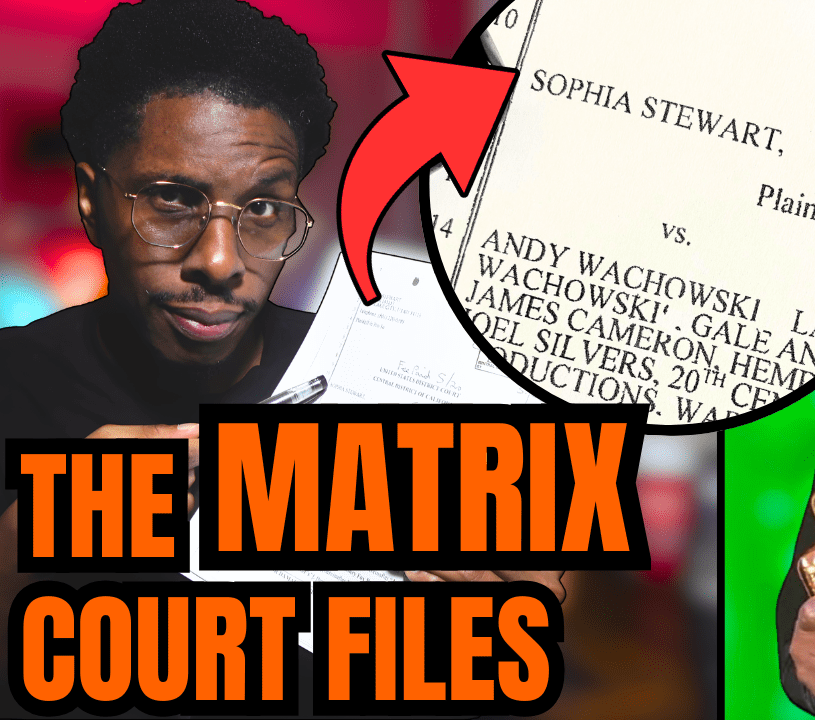
Sophia Stewart Matrix Terminator Lawsuit: What the Court Actually Ruled
For more than twenty years, the internet has circulated a story claiming that a writer named Sophia Stewart created The Matrix and The Terminator, and that Hollywood stole her work.
The story often includes claims that she won billions of dollars in court or that the studios secretly settled the case.
But the actual federal court record shows something very different.
Watch the Full Investigation
This video walks through the actual lawsuit, the manuscript, and the court’s reasoning step by step.
This article explains the lawsuit Stewart v. Wachowski, what evidence was presented, and why the court dismissed the case.
You can also review the actual documents from the case, including the complaint and the manuscript Stewart claimed was copied.
Case Documents
Original Lawsuit Complaint
Quick Answers
Did Sophia Stewart write The Matrix?
No.
The Matrix is officially credited to Lana and Lilly Wachowski, who wrote the screenplay in the 1990s.
Sophia Stewart claimed that her manuscript titled The Third Eye was used to create both The Matrix and The Terminator, but a federal court dismissed the lawsuit.
Did Sophia Stewart win the Matrix lawsuit?
No.
In 2005, a federal court granted summary judgment for the defendants in the case Stewart v. Wachowski.
This means the judge ruled that the evidence presented could not support a finding of copyright infringement even if the case went to trial.
Why did Sophia Stewart lose the lawsuit?
The court ruled that the evidence presented was insufficient to prove copyright infringement.
Specifically, the court concluded that Stewart did not produce admissible evidence showing:
• that the filmmakers had access to her manuscript
• that the films were substantially or strikingly similar to her work
Because of that, the case was dismissed.
Did Sophia Stewart win billions of dollars?
No.
The claim that Stewart won billions of dollars comes from a separate malpractice lawsuit she later filed against former attorneys.
That case did not determine whether The Matrix copied her work.
The court also rejected Stewart’s attempt to calculate damages using internet profit figures from the films.
The Manuscript Behind the Claim
Sophia Stewart’s claim centered on a science-fiction work called The Third Eye.
According to the court record, she described two main versions of the work:
• a six-page screen treatment written around 1981, registered in February 1983
• a longer manuscript written around 1983, registered in February 1984
Stewart argued that these materials were copied and used to create both The Terminator and The Matrix.
The Lawsuit: Stewart v. Wachowski
The federal case most frequently cited online was filed in 2003.
Stewart v. Wachowski
United States District Court
Central District of California
The defendants included people associated with both franchises.
Terminator defendants
• Twentieth Century Fox
• James Cameron
• producer Gale Anne Hurd
Matrix defendants
• Warner Bros.
• the Wachowski filmmakers
• producer Joel Silver
Stewart alleged copyright infringement and also brought additional claims including RICO allegations.
The central issue was whether the films copied her work.
What the Court Needed to See
To prove copyright infringement, courts typically require two elements.
First, the plaintiff must show that the defendants had access to the copyrighted work.
Second, the plaintiff must show that the defendants copied protectable expression, not just general ideas.
For example:
An idea like a future where machines control humanity is not protected by copyright.
But a specific story involving particular characters, dialogue, and scenes may be protected.
The Terminator Claim
Stewart alleged that she mailed a six-page treatment of The Third Eye to someone working in creative affairs at Twentieth Century Fox.
The court focused on whether the creators of the film themselves had access to the material.
Declarations submitted in the case stated that James Cameron had never seen Stewart’s work and had never heard of her before the lawsuit.
The court also noted Cameron’s statement that the screenplay for The Terminator was completed in 1982, before Stewart said she completed her full manuscript.
Because Stewart did not provide evidence connecting her manuscript to Cameron or the producers, the court ruled that the claim could not proceed.
The Matrix Claim
For The Matrix, Stewart argued that she submitted her manuscript to the Wachowski brothers in 1986 in response to a magazine advertisement seeking science-fiction works.
She also argued that characters in the films corresponded to characters in her manuscript.
Examples she pointed to included:
• I-Khan and Neo
• Vashta and Morpheus
• Trifina and Trinity
• Awn and Cypher
However, the court concluded that the evidence presented was insufficient to prove copying.
One issue was that the similarity evidence relied heavily on a single page containing photographs of characters from The Matrix.
The court ruled that these photographs did not allow a factfinder to meaningfully compare features such as height, weight, or personality traits.
The Evidence Problem
Another key issue involved the evidentiary record.
During the summary judgment phase, the court noted that Stewart did not submit copies of the Terminator or Matrix films into evidence.
Because of this, the court stated that it could not conduct the comparison necessary to evaluate the similarity claims.
Without admissible evidence supporting access or striking similarity, the court ruled that no reasonable jury could find copyright infringement.
Summary Judgment and Case Dismissal
In June 2005, the court granted summary judgment for the defendants.
This means the judge ruled that even if the case went to trial, the evidence presented could not support a verdict for the plaintiff.
As a result:
• the case was dismissed
• no damages were awarded
• the court did not rule that the films infringed Stewart’s work
The Malpractice Lawsuit
After losing the copyright case, Stewart later filed a malpractice lawsuit against some of her former attorneys.
That case led to confusion online because one of the attorneys eventually defaulted.
However, that default judgment was related to legal malpractice, not to the question of whether The Matrix copied Stewart’s work.
The damages awarded were connected to litigation costs, not film profits.
Why the Myth Persisted
Despite the court ruling, the story that Stewart “won the Matrix case” continued to circulate online.
Part of the confusion came from early internet reporting errors and the later malpractice lawsuit.
But the federal court record in Stewart v. Wachowski shows that the copyright claims were dismissed.
Sophia Stewart’s lawsuit against her lawyers: Case Number: 2:07CV 552 DB-EJF
Related Readings:
About the Author