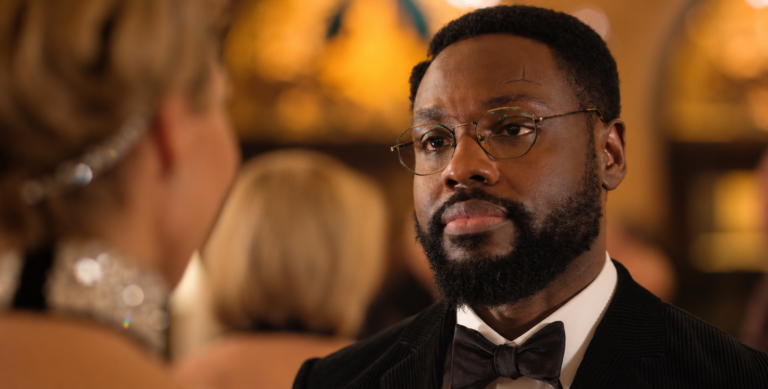
Leighton believes safeguards can manage the risks of multiverse travel, but Episode 7 tests that confidence.
Leighton’s pyramid has an unanswered safety problem: expanding multiverse travel does not establish that he can manage every traveler who uses it. In Dark Matter Season 2 Episode 7, Blair’s experience, Ryan and Amanda’s outbreak, and Oluko’s behavior test his confidence in safeguards.
Leighton acknowledges that travel can have terrible consequences. He believes procedures can reduce those risks enough to continue his project. My concern is what happens when travelers change during a journey, their variants take different routes, or his collaborators pursue different goals.
The episode gives us evidence for those concerns. It does not prove that the pyramid will fail or that every precaution would be useless.
Spoilers through Dark Matter Season 2 Episode 7.
Watch the full breakdown below, then keep reading for the evidence and what it could mean for Leighton’s plan.
Join our Sunday live streams at 1 p.m. Pacific to discuss Dark Matter and bring your own interpretation. This week’s stream features the Mega Sour challenge, following last week’s Death Nut challenge.
Why does Blair reject Leighton’s safeguards?
Blair rejects Leighton’s confidence because she has experienced how a journey can change the person navigating it. Her objection comes from what happened after she entered the Box with hope.
In Season 1, Jason and Amanda found Blair inside an abandoned Velocity facility in the murder-hornet world. She refused to leave with them. Episode 7 develops the experiences behind that decision.
During her travels, armed men confronted Blair in a field, and someone blocked her attempt to retreat into the Box. Fear and anger began taking over. Those emotions affected the worlds she reached next, which exposed her to further danger.
That creates a cycle. A frightening encounter changes the state of mind she brings to the next door. The next dangerous world then makes her more frightened and angry.
Blair also believes her travels introduced the hornet catastrophe. The precise sequence of that transfer needs care; we should not invent an unseen chase through the corridor. Her account nevertheless explains why she refuses to help expand access.
A departure briefing cannot guarantee a traveler’s later judgment. Leighton’s procedures would have to remain effective after the experiences of the journey have changed that person.
The pyramid’s door permits refugees and armies
The pyramid’s large entrance expands what Leighton could move between worlds. Blair identifies a military application, while Leighton describes rescuing refugees from a dying world.
On Sunday’s stream, I said the pyramid’s exterior only told us so much. I wanted to see the door because its dimensions would reveal what could actually pass through it. I raised tanks and armies as possibilities.
This week, Blair looks at an entrance large enough for a semi-truck and raises the possibility of moving an army. Leighton’s refugee response describes a valuable use of that capacity. A route out of a dying world could save lives.
However, both uses fit through the same door. His humanitarian intention cannot determine every future use of the technology. The outcome also depends on who controls access and authorizes a journey.
What does the proposed 30-day patch change?
Low-tech Ryan’s proposed patch would extend the time people can travel under the drug’s effects. The intended duration is 30 days, while the reported trials have reached two weeks.
A longer window could help teams investigate destinations, retrieve equipment, or organize rescues. It could also create more opportunities to encounter unfamiliar threats.
If travelers acquire something harmful without realizing it, additional travel could expose more worlds before they return. That is a potential consequence, rather than a confirmed outcome of the patch.
The larger entrance expands transport capacity. The patch expands potential travel duration. Each improvement increases what Leighton’s safeguards must account for.
How did Ryan and Amanda infect their perfect world?
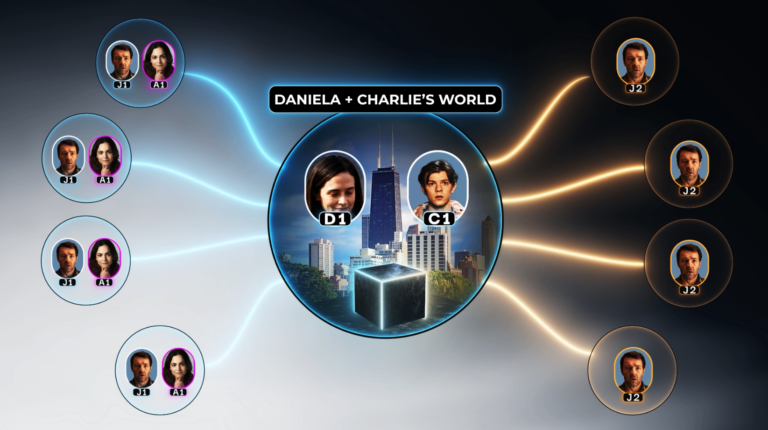
An infected variant of Ryan introduced the plague, with another Amanda accompanying him. The healthy Ryan and Amanda we follow returned later, without having experienced the journey that infected their counterparts.
Earlier, some of us in the community suspected Leighton. Others reconsidered Jason and Amanda’s Season 1 visit to a plague world and wondered whether they had carried the infection. Episode 7 corrects those suspicions by identifying another Ryan as patient zero.
The three Ryan histories
- The native Ryan: This world’s Ryan died in a hyperloop accident ten years earlier.
- The infected traveler: Another Ryan arrived with Amanda four weeks before the healthy pair returned. The investigation identifies him as patient zero.
- The Ryan we follow: He returns healthy and cannot explain an infection he never experienced.
The authorities initially connect the outbreak to Ryan’s sister. Footage from her home then shows another Ryan and Amanda in bed, bleeding and dying. Ryan blames himself for what happened.
The healthy Ryan watches himself dying beside Amanda after learning that his sister is dead. The investigators expect him to explain how he survived. Yet the face they recognize belongs to someone with a different travel history.
An earlier return does not require time travel
Different branches can return at different points while other travelers continue their journeys. The infected pair’s earlier arrival therefore does not require a trip into the past.
The episode also does not identify the exact world where those counterparts contracted the disease. Knowing their arrival date is not the same as knowing every destination they visited.
For background on their search, see Rawteur’s earlier analysis of Amanda and Ryan’s journey and its connection to Jason’s world.
Why the operation’s 74 worlds raise another concern
Leighton’s operation has already visited 74 worlds. That establishes a substantial travel history, but it does not let us calculate how many variants exist.
A report from one scout cannot automatically describe the destinations visited by another version of that scout. Ryan and Amanda demonstrate the distinction: their own memories cannot account for their counterparts’ infection journey.
Screening and quarantine could reduce biological risks. The outbreak does not establish that those measures would fail. It shows why Leighton would need protections for returning travelers whose experiences differ from the journeys his team supervised.
What does Oluko’s surveillance of Blair suggest?
Oluko’s decision to have Blair watched raises the possibility that his priorities differ from Leighton’s humanitarian mission. It does not confirm a plan to sabotage the pyramid.
I previously questioned Oluko’s ambitions after his vision of worship and power. His calm presentation did not resolve what he wanted from access to other worlds.
At the end of Episode 7, Leighton lets Blair leave after she refuses to participate. Oluko then tells Sandra to find her and keep her under observation. His response adds scrutiny after Leighton has allowed her to walk away.
We do not know how much Leighton understands about Oluko’s ambitions. However, this gives us a concrete reason to question whether they agree about how to treat someone who rejects the project.
Oluko already has a role inside the operation. Access restrictions depend on the judgment of the people applying them, so Leighton’s safety plan also depends on understanding his collaborators.
Does Episode 7 prove Leighton’s pyramid will fail?
No. Episode 7 exposes unresolved risks without proving that Leighton’s entire project must fail. Travel can deliver useful solutions, and safeguards could prevent particular mistakes.
My reading is that Leighton’s confidence runs ahead of what he has demonstrated. He wants to expand access while the episode shows how travelers’ experiences and intentions can escape the expectations they started with.
Making the pyramid operational would demonstrate greater transport capacity. Whether Leighton can govern the consequences of that capacity remains unanswered.
Dark Matter Season 2 Episode 7 FAQ
Is the healthy Ryan patient zero?
No. The investigation identifies the infected Ryan who arrived earlier as patient zero. The healthy Ryan did not experience that counterpart’s infection.
Were Ryan and Amanda away for exactly four weeks?
The infected pair’s arrival four weeks earlier does not, by itself, establish the healthy pair’s exact trip duration. That date establishes when the other pair returned, rather than when this pair departed.
Do 74 worlds mean 74 variants?
No. The number of worlds visited does not provide a count of traveler variants. The episode does not supply enough information to calculate that number.
Has the 30-day patch completed a full-month trial?
The reported trials have reached two weeks. Thirty days is the intended duration under development.
Has Leighton earned the confidence he has in his safeguards? Share your interpretation in the comments, and bring your argument to our Sunday Dark Matter discussion at 1 p.m. Pacific.
About the Author