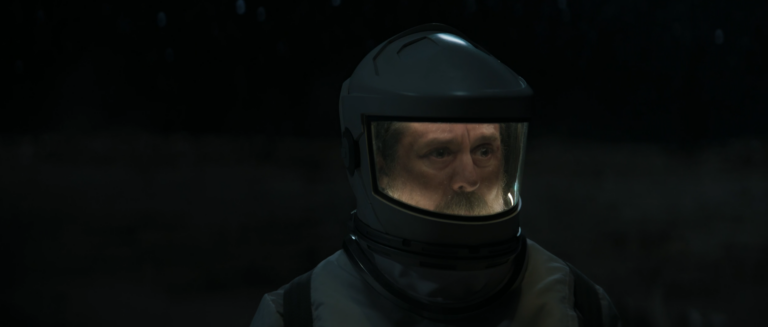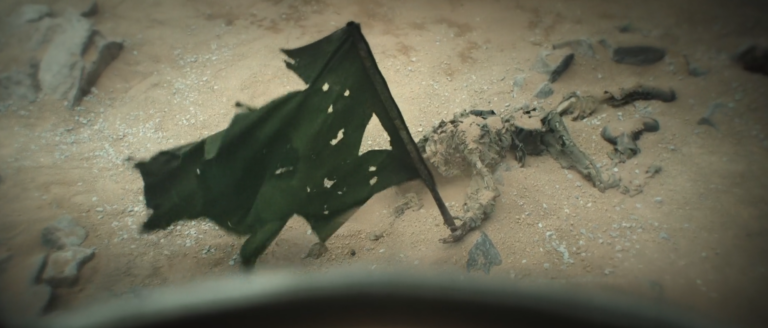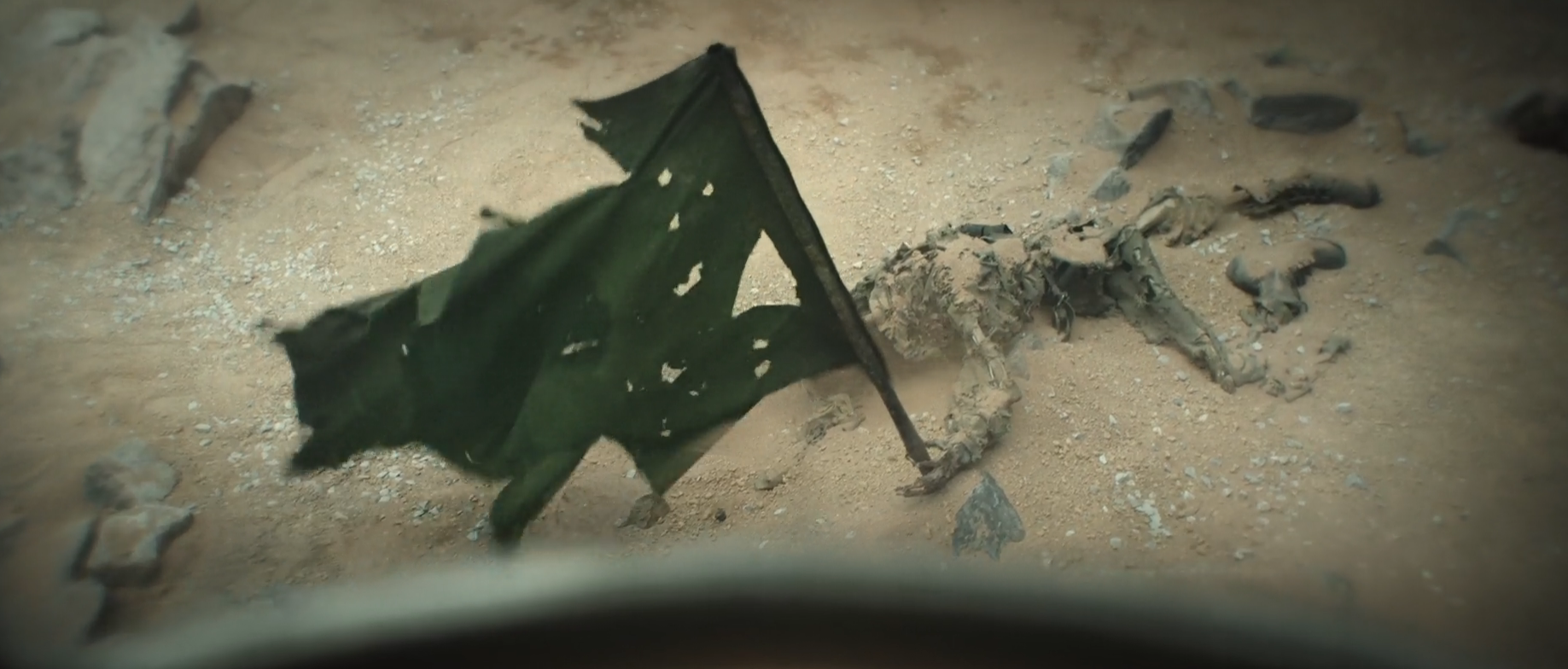
One of the bodies outside Silo 17 lies beside a torn green flag.
Silo 17’s residents likely died because capping the Safeguard pipe stopped only the system’s first kill mechanism. Silo Season 3 Episode 7 strongly suggests that another defense—possibly armed drones, an exterior nanocloud or both—could still attack anyone who escaped.
That explanation is not fully confirmed. The bodies outside prove that the rebellion ended in mass death, but they do not prove whether the residents were killed by the air, delayed exposure to the Safeguard or a second weapon deployed after they opened the door.
This article contains spoilers through Silo Season 3 Episode 7.
Watch the full Hidden Details breakdown below, then keep reading for the evidence that Silo 17 may have defeated one Safeguard and triggered another.
Why Did Silo 17 Die After Stopping the Safeguard?
Silo 17 died because stopping the pipe did not remove every way the system could kill or contain the population. Solo explains that his parents capped the Safeguard line, and the Voice later tells Camille that the silo only prevented the system “momentarily.”
The wording separates the pipe from the final disaster. Silo 17 appears to have blocked whatever was supposed to enter through that line. The residents then survived long enough to rebel, open the airlock and leave. Something else killed most of them after that victory.
The Voice uses the bodies as proof that resistance is futile. It shows Camille Juliette’s unedited cleaning footage and asks what she saw outside Silo 17. Camille answers: bodies. The image is real, but the explanation surrounding it is incomplete.
Those bodies prove the population died. They do not prove that the capped pipe failed.
What Solo Said About the Cloud Returning
Solo’s account provides the strongest evidence for a second attack. He says the people inside Silo 17 initially survived after the Safeguard was stopped, but then the cloud came back.
That sequence matters. If capping the pipe had simply failed, the system could have killed the residents inside the silo through the original route. Instead, the adults reached the surface and died around the entrance. Solo’s description suggests a delay between defeating the internal mechanism and the arrival of a new threat.
Solo was a child when the rebellion happened, so his interpretation may be honest without being technically complete. He could identify a returning cloud without knowing whether it was toxic dust, programmable nanotechnology or material disturbed by machines outside.
The distinction is especially important because the series has already shown a destructive nanocloud in the Before Times. That technology can intercept aircraft and weapons, which makes a weaponized cloud around the silos plausible. However, Episode 7 stops short of confirming that the same technology killed Silo 17.
Did Drones Kill the People From Silo 17?
Armed drones may have killed some or all of the Silo 17 residents, but the bodies have not been examined closely enough to confirm bullet wounds.
Episode 7 gives the theory new support when Lukas Kyle and Patrick Kennedy approach Silo 17. They hear mechanical buzzing followed by gunfire. The sound sequence suggests an exterior defense operating in the same area where the earlier population died.
If drones surround the silos, Silo 17’s history becomes easier to reconstruct:
- The rebels cap the internal Safeguard pipe.
- The population survives the first planned release.
- The residents open the silo and move outside.
- An exterior defense responds with drones, a nanocloud or both.
- Most adults die near the entrance while Solo and the children remain inside.
This sequence fits the Voice’s claim that the Safeguard was prevented only temporarily. It also explains why disabling the pipe does not automatically make opening the door safe.
The missing proof is physical. We have not been shown clear gunshot wounds on the bodies, a drone on screen or an explicit command activating a second defense. The theory is strongly supported, not confirmed.
Why Didn’t the Same Defense Kill Juliette?
Juliette’s survival is the largest problem with any claim that the system possesses unlimited control outside. She crossed from Silo 18 to Silo 17 in daylight while the Voice wanted her contained, yet no visible drone or cloud stopped her.
Several explanations remain possible. The exterior defense may activate only after a silo disables its Safeguard or opens under unauthorized conditions. It may be controlled by Silo 1 rather than by the Voice speaking to Camille. The system may also have needed Juliette alive, although its later attempts to erase her memories make that explanation less convincing.
Another possibility is simple limitation. The Voice may control the systems connected to Silo 18 more reliably than the territory between silos. It can manipulate the water, cameras, doors, suits and people inside. Outside, it may need another silo or automated defense to respond.
That possibility connects directly to why the Voice approved Juliette’s Silo 17 mission. Approving the trip did not necessarily mean the Voice could personally guarantee the outcome. It may have expected another part of the larger system to stop Lukas and Kennedy.
Is the Safeguard Poison, Nanotechnology or Something Else?
Episode 7 does not establish one substance as the complete Safeguard. The evidence increasingly supports a layered system with several delivery methods.
The capped pipe appears to be one route into a silo. Vitamin D Plus and the water system may provide another way to alter or control the population. The destructive cloud from the Before Times demonstrates that nanotechnology can also operate in an external weaponized form.
These mechanisms do not have to be mutually exclusive. A programmable system could use one form for memory suppression, another for mass killing inside a silo and an external version against people or aircraft on the surface.
This would explain why the Voice speaks about the Safeguard as inevitable even after acknowledging that Silo 17 stopped the pipe. The Voice may be describing the entire containment architecture while Juliette is focused on one line beneath Judicial.
Why the Bodies Do Not Prove the Outside Air Is Toxic
The bodies outside Silo 17 do not independently prove that the natural atmosphere killed the residents. They prove only that the residents died after leaving.
The people of Silo 17 apparently believed they had stopped the threat inside. Their decision to open the door suggests they expected the exterior to be survivable, or at least preferable to remaining underground. The location of the bodies shows that their belief ended catastrophically, but not why.
The show continues to preserve several causal possibilities:
- The outside atmosphere is naturally lethal.
- The residents carried delayed exposure from the Safeguard.
- A returning nanocloud killed them.
- Armed machines attacked them near the entrance.
- More than one defense operated at the same time.
Episode 7 strengthens the final three possibilities because a new pair of travelers encounters machinery and gunfire in the same location.
What This Means for Juliette’s Plan
What Episode 7 established: The Safeguard pipe can be stopped, but Silo 17’s population still suffered a mass-casualty event. A mechanical threat appears to confront Lukas and Kennedy outside, and Kennedy apparently survives long enough to reach Silo 17.
What the evidence suggests: Juliette cannot save Silo 18 merely by copying the cap. She also needs to identify the defense that killed Silo 17’s adults and determine why it did not kill Solo, the children or Kennedy.
That makes Lukas’s investigation more important than locating a piece of machinery. Silo 17 may contain evidence of the order in which its defenses activated. If the cap worked, it proves that one part of the system can be defeated. If the drones also failed to kill Kennedy, the supposedly inevitable backup can be defeated too.
Silo 17 and the Safeguard FAQ
Did Silo 17 stop the Safeguard?
Yes, Silo 17 appears to have stopped the Safeguard pipe temporarily. The Voice confirms that the silo prevented it “momentarily,” but another event still killed most residents.
What killed the people outside Silo 17?
The exact cause remains unconfirmed. A returning nanocloud, armed drones or another external defense are the strongest current explanations.
Why did Solo and the children survive?
Solo and the children remained inside Silo 17 while most adults went outside. Their location may have protected them from an exterior defense activated after the airlock opened.
Is the air outside the silos safe?
The series has not confirmed that the natural air is safe. Juliette’s survival proves that crossing between silos is possible with protection, but it does not isolate the atmosphere from the other threats operating outside.
Can Juliette save Silo 18 by capping its pipe?
Capping the pipe could stop one Safeguard mechanism, but Silo 17 shows that Juliette must also account for whatever killed the residents after they escaped.
Final Takeaway
Silo 17 probably defeated the internal Safeguard and then encountered a second defense outside. Solo’s cloud account, the location of the bodies and the mechanical buzzing around Lukas and Kennedy all support that sequence.
The exact weapon remains unresolved. What Episode 7 changes is the assumption that the bodies prove the cap failed. They may instead prove that the cap worked well enough to force the system to reveal its next weapon.
About the Author