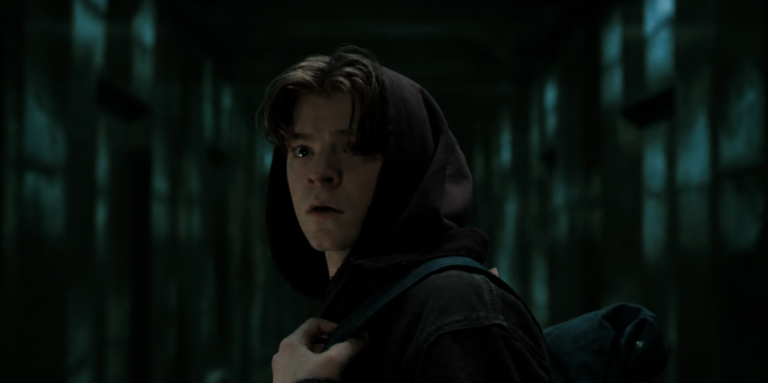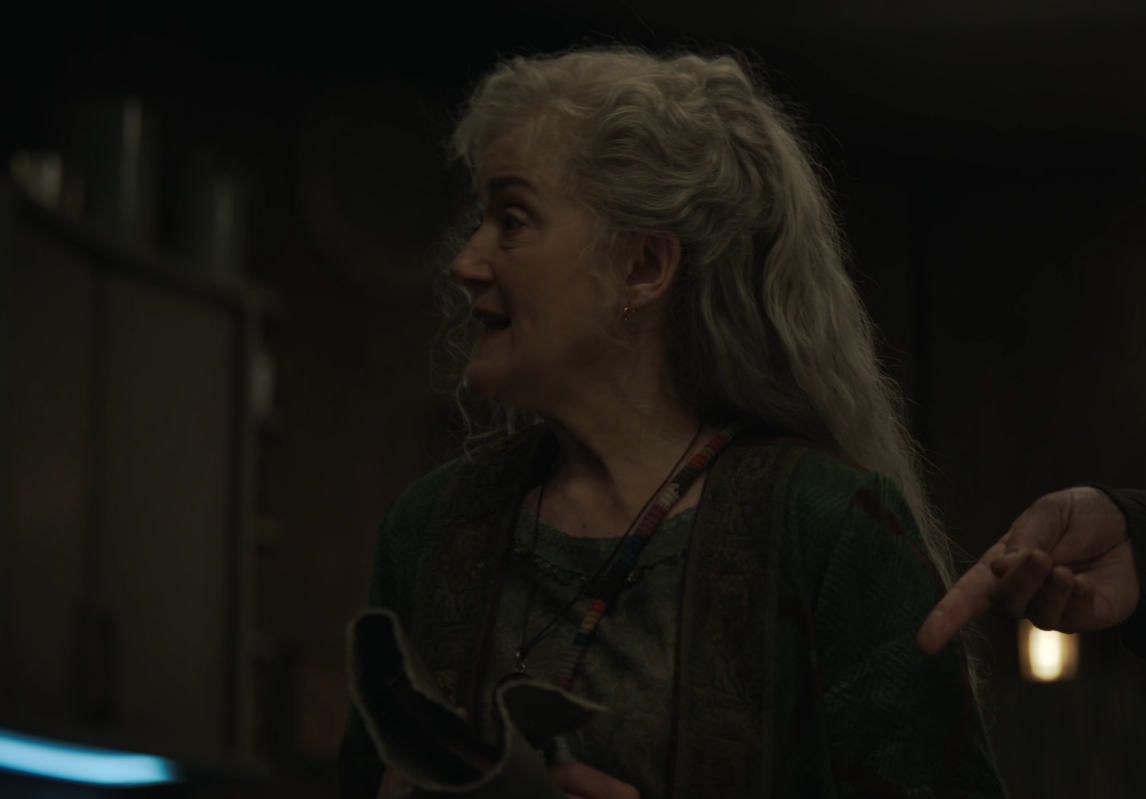
Gloria uses Mission’s diary to reveal what happened during Silo 18’s previous Full Reset.
Mission’s diary reveals that Silo 18’s previous Full Reset erased parts of residents’ memories and caused widespread confusion, starvation and suicide. Approximately 2,000 people died even though the system classified the reset as successful because the silo itself survived.
The diary changes what “successful” means in Silo. The reset preserved the institution for another 140 years, but it was not controlled or safe for the people forced to live through it.
This article contains spoilers through Silo Season 3 Episode 7.
Watch the full Hidden Details breakdown below, then keep reading for what Mission recorded, how the stairwell nets may preserve physical evidence and what the diary reveals about Vitamin D Plus.
What Did Mission’s Diary Reveal About Silo 18’s Previous Reset?
Mission’s diary reveals the human cost hidden behind the Voice’s description of a successful Full Reset. Residents lost pieces of their memories and could no longer understand important parts of their own lives. Some stopped eating. Others jumped from the silo’s stairs. Approximately 2,000 people died during the confusion.
Silo 18 nevertheless continued functioning. Its population recovered, essential knowledge survived and the rebellion that caused the reset disappeared from common history. From the system’s perspective, that outcome counted as success.
The diary gives us a different measurement. Twenty percent of a 10,000-person population can die while the Voice still considers the procedure effective, as long as enough residents remain to operate the silo and the rebellion is forgotten.
That distinction explains why the reset can be presented to Camille as a survivable alternative while remaining catastrophic for everyone who drinks the water.
When Did Silo 18’s Previous Full Reset Happen?
Silo 18’s previous Full Reset happened approximately 140 years before the current story. The Voice had already told Camille that Silo 18 was one of six silos to survive a successful reset, but Mission’s diary provides the missing ground-level account.
The time gap explains why nobody in the present population remembers the event directly. The reset removed or disrupted the memories of those who experienced it, while later generations inherited a silo with rewritten history and few surviving records.
Mission’s diary survives because handwritten material can preserve information outside the official digital systems. It does not merely tell Juliette that a reset happened. It documents how people behaved when their personal history disappeared.
That makes the diary dangerous to the Voice. It restores the cost that the word “successful” was designed to hide.
Why Did People Stop Eating After the Reset?
People stopped eating because the reset did not simply remove one political fact. It disrupted the memories and relationships that gave ordinary behavior meaning.
A resident might retain the physical ability to eat while forgetting the routine, emotional connection or personal history surrounding daily life. Someone could know how to perform a job yet fail to recognize why a family member mattered. That uneven damage would produce a population capable of basic movement but unable to reconstruct itself cleanly.
Season 3 has already shown smaller versions of the same problem. Juliette can still repair machinery while losing memories of Lukas, her father and her own recent choices. Charlotte requires Daniel to repeat her history because facts do not automatically rebuild identity after traumatic memory loss.
Mission’s account shows what happens when that instability affects thousands of people simultaneously and no trusted person remains outside the reset to rebuild everyone’s story.
Did the Previous Reset Cause the Stairwell Nets?
The stairwell nets may have been installed because people jumped to their deaths during the previous reset. Episode 7 does not explicitly state when the nets were added, but Mission’s diary and the present-day architecture create a strong connection.
Gloria reads that residents leapt from the stairs during the confusion. Centuries later, heavy nets still stretch across the central stairwell. Those nets have always looked like a practical safety feature in a vertical city, but the diary gives them a specific historical purpose.
If the connection is correct, the nets are physical evidence that survived even after the event itself was erased from collective memory. Residents walk past a structure built in response to the last reset without knowing the deaths that made it necessary.
That is exactly how the silo preserves function while removing context. The safety solution remains; the reason for it disappears.
Why Was the Reset Considered Successful if 2,000 People Died?
The reset was considered successful because the system measures survival at the silo level, not the individual level. Silo 18 remained operational, the rebellion was neutralized and enough of the population survived to continue for another 140 years.
That calculation matches the way the Voice evaluates every major decision. It rejects Knox and Shirley for Juliette’s mission because losing them would reduce the silo’s projected lifespan by 34 percent. It evaluates people according to their contribution to the larger machine.
Mission’s diary reveals the brutal endpoint of that logic. Two thousand deaths can be accepted if the remaining population is easier to control and still possesses the technical knowledge required to keep the silo alive.
The Full Reset is therefore not designed to preserve every person. It is designed to preserve continuity.
What Does Mission’s Diary Reveal About Vitamin D Plus?
Mission’s diary shows the kind of population-wide damage Vitamin D Plus may be intended to reproduce. It does not identify the exact substance inside the barrels or prove how the current reset works.
Camille has already ordered Vitamin D Plus into Silo 18’s water while reverse-osmosis filtration is disabled. Ordinary Vitamin D cannot selectively erase memories, so the label is almost certainly a cover for another agent or delivery system.
The earlier reset suggests that the agent does not erase every memory evenly. Silo 18 continued functioning, which means residents retained enough technical and practical knowledge to maintain Mechanical, Supply, the farms and IT. What disappeared was the history surrounding the rebellion and parts of the personal identity connected to it.
That pattern fits the selective memory damage affecting Juliette and the targeted procedure Kennedy previously requested. The current water operation appears to be the population-level version.
For more on the decision behind that operation, read why Camille is still helping the Voice.
Could Silo 18 Survive Another Reset?
Silo 18 could survive another reset as an institution, but Mission’s diary shows that thousands of residents may not survive the process.
The present reset may also be more dangerous because the silo is already unstable. Juliette’s return exposed the display, Mechanical has challenged Judicial, the Outsiders have built a resistance network and important residents already know that other silos exist. The Voice would need to remove more interconnected information while preserving the knowledge required to repair damage from the rebellion.
The population also has evidence the previous residents lacked. Juliette, Gloria, Walker, Bernard and others understand at least part of the memory-control system. Sims and Bernard had three months to prepare, and handwritten records like Mission’s diary can restore information after the official history is erased.
The system may be repeating the same procedure, but it is not operating against the same level of awareness.
What This Changes Going Forward
What Episode 7 established: Silo 18 survived a previous Full Reset approximately 140 years ago, but around 2,000 people died from the confusion and behavioral collapse that followed. The system still classified the result as successful.
What the evidence suggests: The present population is not choosing between harmless forgetting and death. The reset itself can produce mass casualties, destroy families and leave permanent architectural scars. Mission’s diary gives Juliette proof that the Voice’s definition of survival is radically different from her own.
The diary may also become a reconstruction tool. Even if the current reset begins affecting memories, written accounts can help surviving residents recognize what was taken from them and rebuild the history the Voice wants removed.
Mission’s Diary and the Full Reset FAQ
Who was Mission in Silo?
Mission was a resident whose diary preserved a personal account of Silo 18’s earlier rebellion and Full Reset. The record survives long after the population forgot the event.
How many people died during Silo 18’s previous reset?
Approximately 2,000 people died during the confusion following the reset.
Why did people jump from the stairs?
Mission’s diary connects the suicides to the disorientation and identity loss caused by the reset. The exact experience of each resident is not documented.
Are the stairwell nets connected to the reset?
The connection is strongly implied but not explicitly confirmed. The diary describes people jumping, while the present silo contains nets positioned to prevent falls through the central stairwell.
Has the current Full Reset already started?
Camille says Vitamin D Plus has entered the water, but Episode 7 shows no confirmed population-wide memory loss yet. The agent may require time, or the operation may have been disrupted.
Final Takeaway
Mission’s diary reveals that Silo 18’s last Full Reset “worked” only under the Voice’s institutional definition of success. The silo survived, the rebellion disappeared from history and the system continued for another 140 years, but approximately 2,000 people died while the population lost pieces of itself.
The stairwell nets may be the physical evidence left behind. The diary restores the explanation, turning an ordinary part of the silo into a reminder of what controlled forgetting actually costs.
About the Author