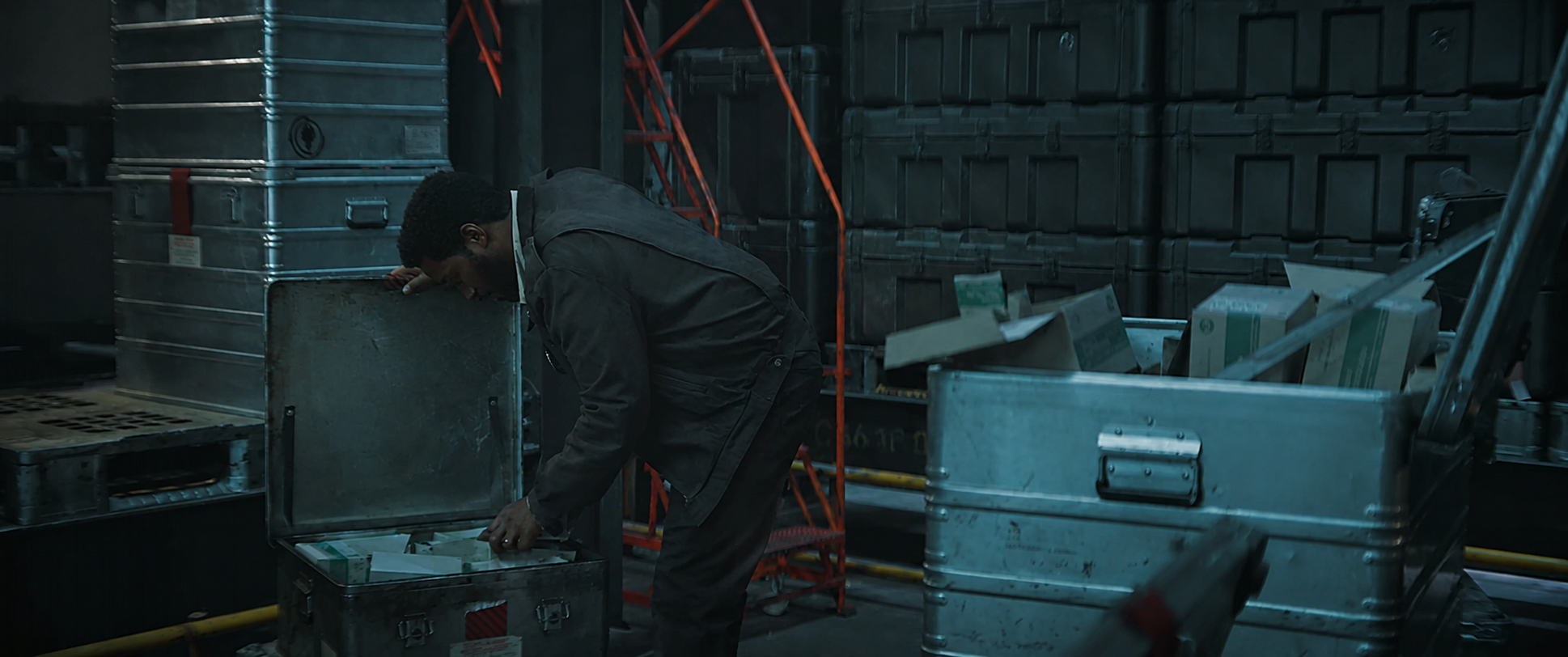
Billings searches Critical Supply while investigating the missing lightbulbs and Day One computers.
Silo Season 3 Episode 8 partially explains who was behind the missing supplies, but it doesn’t reveal where the stolen lightbulbs or Day One computers ended up. Harwood’s rebellion story may explain why he hid essential resources, yet the computers remain the clue that keeps his explanation from feeling complete.
The elevator reveal answers how goods could move between Critical Supply and the Mines without appearing on the main staircase. It doesn’t show the cache, return the bulbs, or explain why historical computing equipment disappeared alongside survival supplies.
Spoiler warning: This article discusses Silo Season 3 Episode 8.
Watch the full breakdown below, then keep reading for what Harwood’s explanation answers and what it leaves unresolved.
Critical Supply Was Missing Decades of Lightbulbs
The crisis begins with a count in Critical Supply. Silo 18 is supposed to have enough specialized bulbs to sustain the farms for decades, but only about two years remain. Without replacements, the farms eventually go dark, crops fail, and the silo loses its food supply.
This isn’t petty theft. Someone removed roughly 50 years of infrastructure from the department responsible for protecting it.
Carla didn’t trust Glenda, so she brought Orla into the investigation. Orla appears to have followed the missing inventory far enough to discover Harwood’s hidden operation. That discovery most likely put her in danger.
Episode 8 then reveals the transportation method. Gus designed something for Harwood, and the investigation leads to a concealed route and elevator connecting the operation around Supply and the Mines.
Harwood’s Explanation Works Better for the Bulbs
Harwood says the operation began during the rebellion. His stated purpose was to keep people from rushing Supply and stripping away resources the silo would need later.
That explanation is plausible for lightbulbs. During a rebellion, centralized supplies can become targets. Moving rare agricultural bulbs into a hidden reserve could be framed as protection, especially if Harwood believed the official system might collapse.
But the quantity creates a problem. Hiding a limited emergency reserve is one thing. Removing approximately 50 years of bulbs while leaving the silo only two years from a food crisis is another.
If Harwood was protecting Silo 18, the bulbs still need to exist somewhere safe and recoverable. Episode 8 doesn’t show that location. It also doesn’t establish whether Harwood intended to return them, whether his network continued taking them long after the rebellion, or whether someone else redirected part of the inventory.
The Day One Computers Don’t Fit a Simple Supply Panic
The Day One computers are the clue that makes this operation feel larger.
People panicking during a rebellion might rush food, medicine, tools, batteries, or replacement parts. Old computers are different. Most residents wouldn’t necessarily know how to operate them, much less understand why they mattered.
That doesn’t prove the machines contain forbidden information. It doesn’t prove Harwood took them personally. It doesn’t even prove they traveled through the elevator.
What it does prove is that the missing inventory can’t be reduced to lightbulbs alone. Someone removed objects connected to the silo’s earliest period, and Episode 8 never returns to that detail.
The computers could have been hidden because of what they contain, because someone wanted to study them, or because their hardware could serve another purpose. Those are possibilities, not answers. Until the show identifies the person who moved them, their location, or their contents, the Day One computers remain one of Season 3’s most important unresolved clues.
The Elevator Explains Movement, Not Destination
Glenda’s seemingly impossible travel helped expose the secret. Cameras placed her in Supply and the Mines with too little time to use the public staircase. Harwood’s elevator solves that part of the mystery.
But a route isn’t a destination.
The episode doesn’t show shelves filled with stolen bulbs. It doesn’t show a hidden computer room. It doesn’t show Harwood controlling a complete inventory of everything taken from Supply.
Therefore, discovering the elevator doesn’t close the theft investigation. It changes the question from “How were they moving the supplies?” to “Where did they move them, and what was the real purpose?”
That shift is especially important because the investigators enter a hole in Supply, disappear from the episode, and later ride upward to Harwood. The unseen portion of that journey could include a storage area, but the show hasn’t confirmed one.
Did Harwood Tell the Whole Truth?
Harwood has a reason to offer an explanation that sounds protective. Building and using the elevator carries the threat of cleaning. Once Knox, Billings, and Hank arrive, he can’t deny the machinery exists.
He responds by explaining the operation and identifying Mike as Orla’s killer. Both disclosures help redirect attention away from Harwood himself.
That doesn’t make his story false. His operation may genuinely have started as an emergency plan during the rebellion. But an origin story isn’t the same as a complete account of everything the operation later became.
The missing bulbs, the missing computers, Orla’s murder, and Harwood’s private transportation system all intersect. Episode 8 connects them, but it doesn’t close them.
What This Changes Going Forward
What Episode 8 established
- Critical Supply is missing roughly 50 years of specialized bulbs.
- Harwood admits running a secret operation that moved supplies.
- He says it began during the rebellion to protect essential resources.
- Gus’s design gave the operation private transportation.
- Orla discovered enough of the operation to create a threat.
What remains unknown
- Where the missing bulbs are stored.
- Whether they can still be returned to the farms.
- Who removed the Day One computers.
- What the computers contain or why anyone wanted them.
- Whether Harwood still controls every part of the operation.
For the full analysis of Gus’s hidden design, read What Did Gus Actually Design for Harwood in Silo Season 3 Episode 8?
Frequently Asked Questions
Where are the missing lightbulbs in Silo?
Episode 8 doesn’t reveal their location. Harwood says supplies were moved for protection, but the show never displays the bulb stockpile.
Did Harwood steal the lightbulbs?
Harwood admits operating the secret supply-moving system and uses the bulbs as an example of what he wanted to protect. The episode ties him to the operation, although it doesn’t reconstruct every removal.
What are the Day One computers?
They are computers associated with the silo’s earliest period. Season 3 identifies them as missing but hasn’t revealed their contents, location, or intended use.
Are the computers inside Harwood’s hidden area?
That hasn’t been confirmed. The elevator could have transported them, but Episode 8 doesn’t show them anywhere in Harwood’s operation.
Final Takeaway
Harwood’s secret elevator answers the movement question. His rebellion story offers a plausible reason for protecting critical supplies. But neither answer tells us where 50 years of bulbs went, why the farms were left with only two years, or why Day One computers disappeared at all.
The bulbs may have been the visible crisis that exposed the operation. The computers could be the clue that reveals what the operation was really protecting.
About the Author