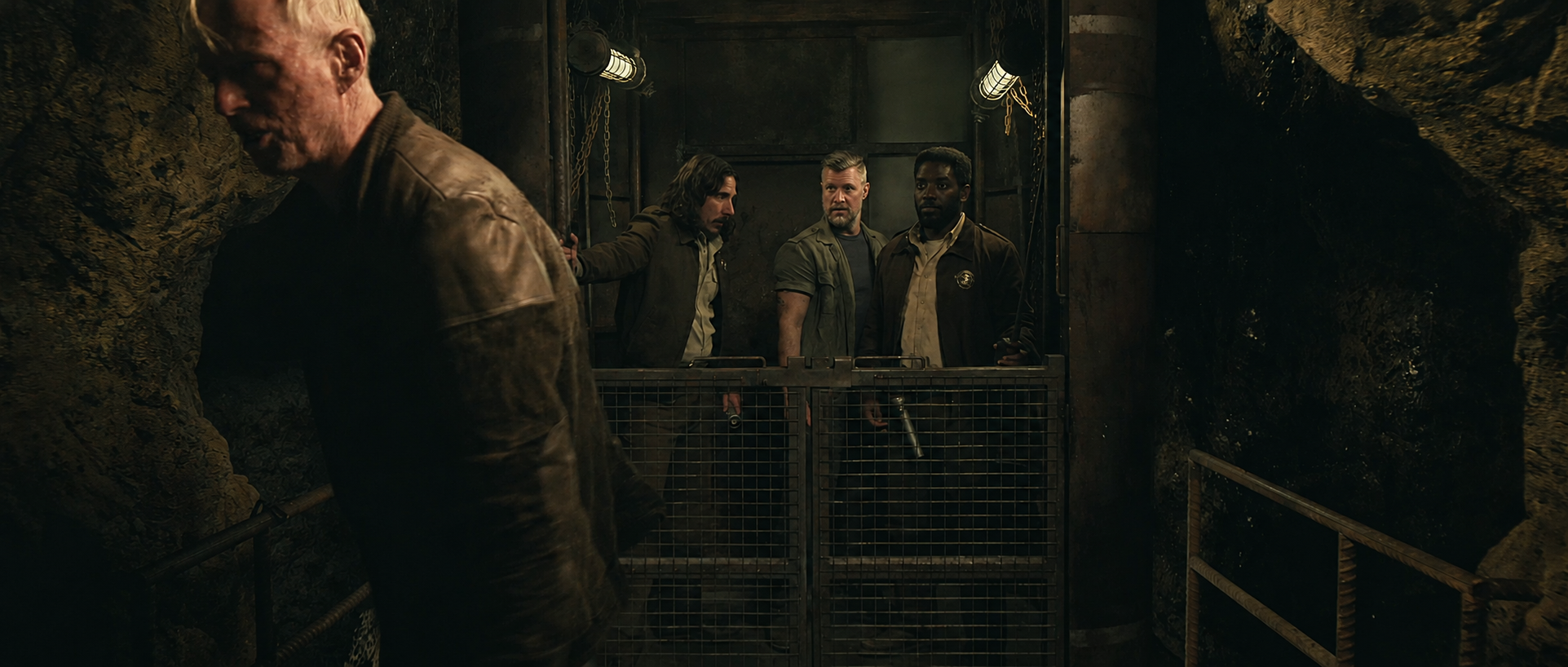
Harwood’s forbidden elevator allows people and supplies to move through the silo without using the public stairs.
Elevators are forbidden in Silo because private vertical transportation would destroy the control created by the staircase. Silo Season 3 Episode 8 never gives the founders’ official explanation, but Harwood’s secret elevator demonstrates the danger: people and supplies can move between departments quickly, privately, and beyond normal observation.
That makes the ban about more than machinery. The stairs regulate time, distance, information, class, and power inside the silo.
Spoiler warning: This article discusses Silo Season 3 Episode 8.
Watch the full breakdown below, then keep reading for why Harwood’s elevator threatens the silo’s entire social design.
The Staircase Is Part of the Silo’s Control System
Silo 18’s residents live inside one enormous vertical structure, but they don’t move through it freely. Every trip between the Up Top, the Mids, Mechanical, Supply, and the Mines takes time and physical effort.
That distance separates communities. It slows the movement of rumors, resources, and organized resistance. It also makes unusual travel visible.
Porters can carry messages and goods, but they operate within an established public system. Deputies, cameras, and witnesses can observe the staircase. A person can’t cross dozens of levels instantly without leaving some kind of trail.
An elevator removes that friction.
Therefore, the staircase isn’t simply an architectural inconvenience. It is a governing tool.
Harwood’s Elevator Shows What the Ban Prevents
Billings’s investigation exposes a major inconsistency in Glenda’s movements. She appears in Supply and the Mines too quickly to have used the stairs.
The secret elevator explains how she did it.
Harwood’s network could move selected people between distant departments while everyone else remained limited by the public route. That speed gave the operation an advantage, but secrecy mattered even more. Glenda could enter one location, disappear behind the walls, and emerge somewhere else without appearing on the expected staircase cameras.
The same system could transport stolen supplies. Critical Supply is missing roughly 50 years of specialized lightbulbs, yet moving that much inventory through public spaces should have attracted attention. A concealed elevator turns an impossible theft into a logistical operation.
This is exactly why private vertical transportation threatens the silo’s rules. It creates a second map available only to the people who control it.
Why Building the Elevator Carries the Cleaning Penalty
Billings makes clear that constructing what Gus designed could send someone out to clean. In the silo, cleaning isn’t a fine or ordinary prison sentence. It is death presented as ritual.
The severity tells us how seriously the system treats unauthorized infrastructure.
An elevator can bypass departmental boundaries. It can move weapons, food, machinery, or people before authorities can respond. It can connect groups that the silo’s geography is designed to keep apart. It can also let a private network accumulate power without public visibility.
Harwood’s operation proves those risks aren’t theoretical. His elevator supports secret movement, concealed inventory, and a chain of events that ends with Orla dead.
The founders may have prohibited elevators because of mechanical limits, energy consumption, or structural safety. Episode 8 doesn’t provide an official policy explanation. But the political result is visible on screen: without elevators, the silo’s leadership can use distance as control.
Elevators Would Change Who Holds Power
The people at the top of Silo 18 possess institutional authority. Mechanical keeps the generator running, but its workers live far below the political center. That distance affects how quickly each group can influence the other.
If Mechanical could reach the Up Top in minutes, a rebellion would move differently. If Judicial could deploy personnel anywhere instantly, enforcement would move differently too. If one private group controlled the only elevator, that group would gain an advantage over both.
Harwood has exactly that advantage. He doesn’t merely possess a machine. He controls access to time.
A journey that takes everyone else hours can take his people minutes. Goods that should require teams of porters can disappear. Departmental boundaries become optional for insiders.
Therefore, the forbidden elevator isn’t dangerous because it goes up and down. It is dangerous because it lets one network ignore the physical rules governing everyone else.
The Alert Beneath Harwood’s Desk Reveals Another Layer
Harwood’s private alert activates when the investigators use the elevator. That detail shows the system was built for controlled access, not public convenience.
The alert gives Harwood time to react whenever someone enters his route. It functions like an early-warning system protecting the operation from discovery.
This combination matters. The elevator conceals movement, and the alarm protects the secrecy of that movement. Gus may have designed the transportation system, its entrances, or both, but Episode 8 keeps the complete plans hidden.
What we can say is that the elevator operates as part of a private security network. That is much more threatening to the Pact than a simple mechanical lift.
Why the Ban Couldn’t Stop Harwood
The Pact can prohibit elevators, but Silo 18 already contains the labor and engineering knowledge needed to build one. Harwood controls the Mines. Gus has the ability to design the system. Supply contains materials, and the hidden space behind the walls gives them cover.
The ban raises the cost of discovery, but it can’t erase the need that creates the machine.
Harwood says the operation began during the rebellion to protect supplies. In other words, instability created a reason to bypass the silo’s official distribution system. Once the private route existed, it could continue serving purposes far beyond the original emergency.
That is another reason the founders would fear elevators. Even if one is built for a defensible reason, whoever controls it can quietly transform it into a permanent alternative power structure.
What This Changes Going Forward
What Episode 8 established
- Harwood operates a hidden elevator connected to a secret route.
- The system allows rapid movement between the Mines and Supply.
- It explains Glenda’s impossible travel time.
- It could support the movement of stolen goods.
- Building it carries the cleaning penalty.
What the evidence suggests
- The elevator ban preserves surveillance and departmental separation.
- The staircase deliberately slows people, information, and resistance.
- Private vertical transportation creates an unauthorized center of power.
- The founders feared what an elevator enables, not only the machine itself.
For the deeper question of whether Gus designed more than the visible elevator, read What Did Gus Actually Design for Harwood in Silo Season 3 Episode 8?
You can also revisit the earlier clues in What Knox’s Father Built for Ed Harwood in Silo
Frequently Asked Questions
Are elevators illegal in Silo?
Yes. Episode 8 establishes that building Harwood’s private elevator is serious enough to carry the cleaning penalty.
Why doesn’t the silo use elevators?
The show hasn’t provided a single official founders’ explanation. The evidence suggests that stairs preserve control by slowing travel, separating departments, and making movement easier to observe.
Who designed Harwood’s elevator?
Gus created the design Harwood used, although Episode 8 doesn’t show the complete drawing or confirm whether the visible elevator was the entire project.
How did Glenda travel so quickly?
Harwood’s hidden elevator provides the most direct explanation for her rapid movement between the Mines and Supply.
Final Takeaway
The founders couldn’t allow private elevators because the silo’s hierarchy depends on controlled movement. The public staircase keeps distance expensive and travel visible. Harwood’s machine makes both restrictions disappear.
His elevator connects people who aren’t supposed to move that quickly, supplies that shouldn’t vanish, and departments meant to remain separated. The machine is forbidden because whoever controls the shortcut can build a hidden silo inside the silo.
About the Author